Love! Laughs! Music! A Forgotten Silent Film Gets a Deluxe Score.
In 1926, a white director and all-Black cast filmed “The Flying Ace” in Florida. Six Black composers are giving it a full musical treatment with the Jacksonville Symphony.
Photographs by Malcolm Jackson for The New York Times
A big-money heist. A war hero. A doe-eyed love interest. A climactic aerial chase.
The silent film “The Flying Ace” has all the ingredients of a riveting action movie, but it may be most remarkable as a historical artifact. Made in Jacksonville, Fla., in 1926 by a white director, the movie depicted Black characters without malice or prejudice during Jim Crow.
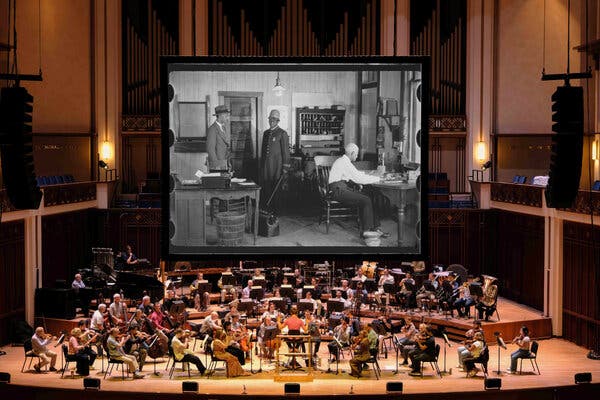
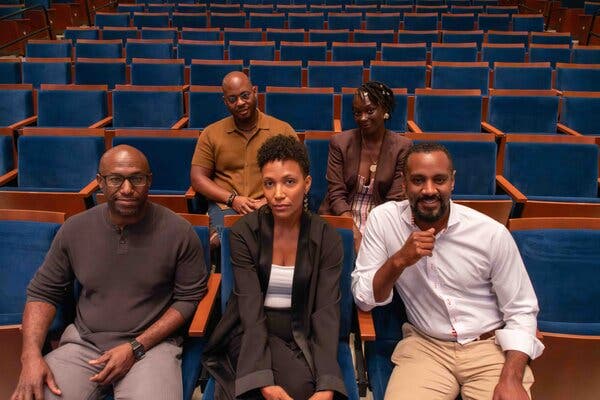
“The Flying Ace,” which was added to the Library of Congress’s National Film Registry in 2021, is seldom screened. On Saturday, though, the Jacksonville Symphony will present it with a new score collaboratively created by six leading Black composers, led by Carlos Simon.
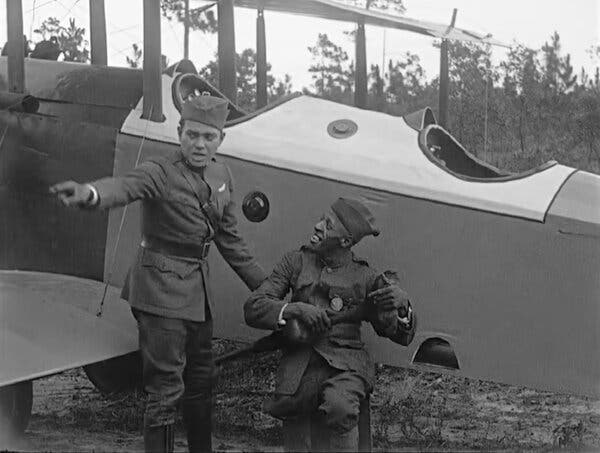
The project spotlights Jacksonville’s past as a moviemaking center in the years before the industry consolidated in Hollywood. “It’s not perhaps something that people would associate with a city like Jacksonville,” said Courtney Lewis, the symphony’s music director. “For us, as an orchestra, to be able to have this project that grows organically from the history of our own city is so exciting.”
“The Flying Ace” was a product of Norman Studios, founded by Richard E. Norman, who had been a magic lanternist, movie accompanist and soda-pop entrepreneur before becoming a film director and distributor. A white man born near Jacksonville in 1891, Norman worked in the movie industry in the Midwest before returning home with a new focus: race films, catering to Black audiences. From 1919 to 1928, he was one of a few white filmmakers to direct movies with all-Black casts. His included westerns like “The Bull-Dogger” (1921) and “The Crimson Skull” (1922) as well as the desert-island drama “Regeneration” (1923).
Of the 30-odd production companies operating in Jacksonville during the silent film era, only the Norman Studios site — now a museum — remains. And of the company’s seven race movies, only “The Flying Ace” survives in its entirety.
Norman had hoped to make a film with the Black aviator Bessie Coleman, whose aerial stunts captivated the nation. But she died in a plane crash — in Jacksonville — shortly before “The Flying Ace” began production.
The film’s protagonist became the fictional Capt. Billy Stokes, a World War I fighter pilot who returns to his prewar job as a railroad detective. Even that premise was extraordinary: At the time, Black people couldn’t get pilot’s licenses in the United States, much less join the Air Service, a predecessor to the Air Force. (Coleman had earned her license in France.)
Allyson Nadia Field, a scholar of Black cinema and silent film at the University of Chicago, described “The Flying Ace” as occupying an alternate, aspirational universe “in which racial conflict doesn’t exist.”
Instead, she added, “the problems within the film are all genre problems: the romance, the bad guy who wants the girl and wants the money.”
That aspirational world seemed to be the frame for all of Norman’s films, as evidenced by surviving clips, scripts and ephemera. His enlightened look at Black life has led some to hail him as a champion of racial equality.
That may well be the case, said Barbara Tepa Lupack, author of the book “Richard E. Norman and Race Filmmaking” (2014). “He looked at Black life not through a limited lens, but through an expanded lens,” she said. At the same time, she noted, Norman stood to capitalize on a booming niche in the industry. In Norman’s heyday, his films rivaled only those of Oscar Micheaux, the pioneering Black filmmaker, in popularity with Black audiences.
“Quite frankly, he was a businessman,” Lupack said. “He recognized that there was this opportunity, and he seized it.”
Even in its hometown, the Norman Studios story can feel like hidden history. Tony Nickle, Jacksonville Symphony’s vice president and artistic administrator, learned about the studio only in 2022, when a composer told him about film posters he had seen at the nearby Cummer Museum. The “Flying Ace” posters promised “Six Smashing Reels of Action! Love! Laughs! Mystery!”
That led to the idea of commissioning six composers, one for each 10-minute reel. Simon, an audience favorite at the Jacksonville Symphony, was recruited as the lead composer and given carte blanche to invite five colleagues, who were encouraged to develop and transform the themes he’d written for the first reel.
Some, like Kathryn Bostic and Jongnic Bontemps, are seasoned film composers. (Bostic had even composed a partial score to “The Flying Ace” for the Academy Museum of Motion Pictures in Los Angeles.) Others came in fresh, like the composer and flutist Nathalie Joachim, who has been widely commissioned but never written for film.
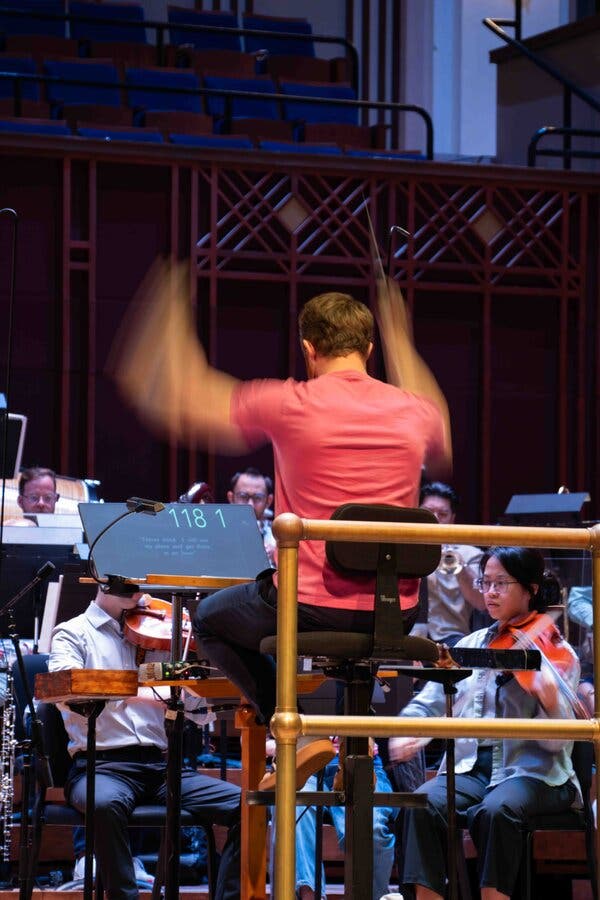
During a dry run of the live score in September, Simon was pleased by how cohesive the final result sounded, even with the different compositional voices. At one end of the spectrum is Simon — his music is sweeping and lush, with the wailing trumpets and clarinets of Jazz Age big bands. At the other end is Joachim, who said her fidgety, glitch-like writing took cues from Carl Stalling, the influential “Looney Tunes” composer. (“He was sampling before sampling was a thing,” she said.)
Many composers took advantage of the precise timing of live film scores to insert sound effects. Levi Taylor wrote a percussion passage that taps along with a character pecking out Morse code. Later in the film, when the villain wallops Captain Stokes with a tree branch, Allison Loggins-Hull marks the moment with an all-orchestra crash.
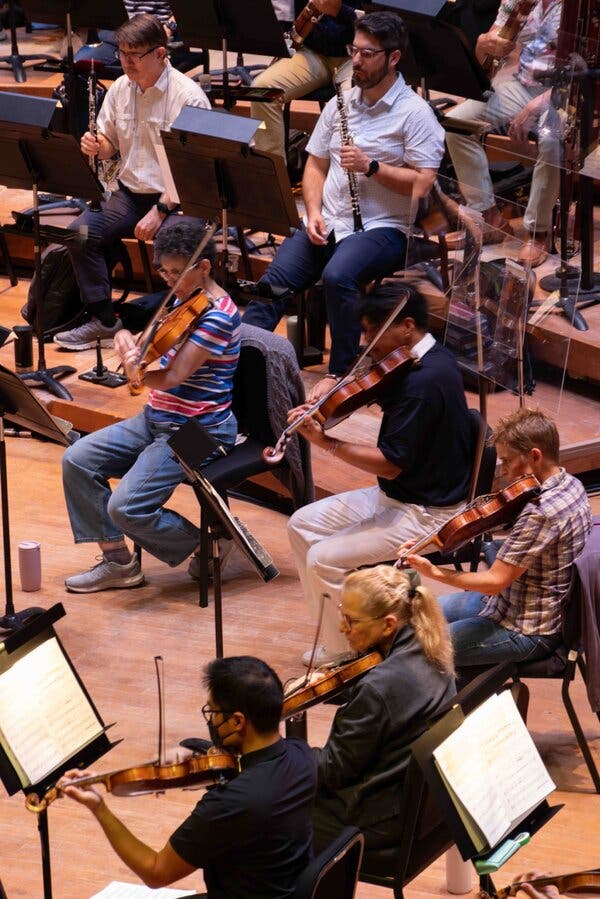
In the 1920s, musical accompaniment to silent films — though some, especially race films, lacked accompaniment — would have been improvised by a single musician or, at most, a small ensemble. (Norman got his start in movies accompanying films in Jacksonville.)
The Jacksonville Symphony is giving “The Flying Ace” its fullest musical treatment to date. But the team is hoping for something more lasting than a one-off. Nickle said he had already heard from other American orchestras and European festivals interested in screening the film with the new score.
The more exposure the better, said Bostic. Despite working in the film industry for decades, she had not heard of “The Flying Ace” until a few years ago. What she saw floored her.
“This should be in the curriculum,” she said. “We all share quirky narrative; we all share the ability to tell these kinds of stories. I found it to be a remarkable and simple way of showing the common denominator.”